Complete Guide to PSG, EDG & SFEC Grants for Singapore SMEs in 2026
Singapore SMEs have three main government schemes that can
significantly reduce the cost of digitalisation projects.
Here is how they work, who qualifies, and how to combine them.
Productivity Solutions Grant (PSG)
PSG supports the adoption of pre-approved IT solutions and equipment,
covering up to 50% of qualifying costs for eligible SMEs.
It suits well-defined, off-the-shelf digitalisation — think
e-commerce platforms, HR/payroll software, and CRM systems from
the pre-approved vendor list.
-
Who qualifies:
registered and operating in Singapore, with at least 30%
local shareholding, and the solution must be used in Singapore.
-
How to apply:
get a quote from a pre-approved vendor, then submit via
the Business Grants Portal (BGP) before making any payment
or signing any contract.
-
Common mistake:
paying a deposit before approval — this disqualifies the application.
Enterprise Development Grant (EDG)
EDG funds larger, custom projects across three pillars:
Core Capabilities, Innovation & Productivity, and Market Access.
Unlike PSG, EDG supports bespoke work — custom software, process
redesign, and overseas expansion — with support levels of up to
50% of qualifying costs for SMEs.
EDG applications need a clear project scope, projected outcomes,
and often a consultant or vendor proposal. Approval takes longer
than PSG (typically 8–12 weeks), so build it into your project timeline.
SkillsFuture Enterprise Credit (SFEC)
SFEC gives eligible employers additional credit to offset
out-of-pocket costs on supportable programmes — including many
PSG and EDG projects. If your business qualifies, SFEC stacks
on top of the base grant, reducing your net cost further.
How to stack them
-
Check whether an off-the-shelf, pre-approved solution meets
your need (PSG) — it is the fastest route.
-
If the project is custom or strategic, scope it for EDG instead.
The same project cannot claim both.
-
Apply SFEC credit against your remaining out-of-pocket share
where eligible.
Grant percentages, caps, and solution lists are reviewed regularly —
always confirm current terms on the GoBusiness portal before committing.
A good vendor will run this check with you before quoting.
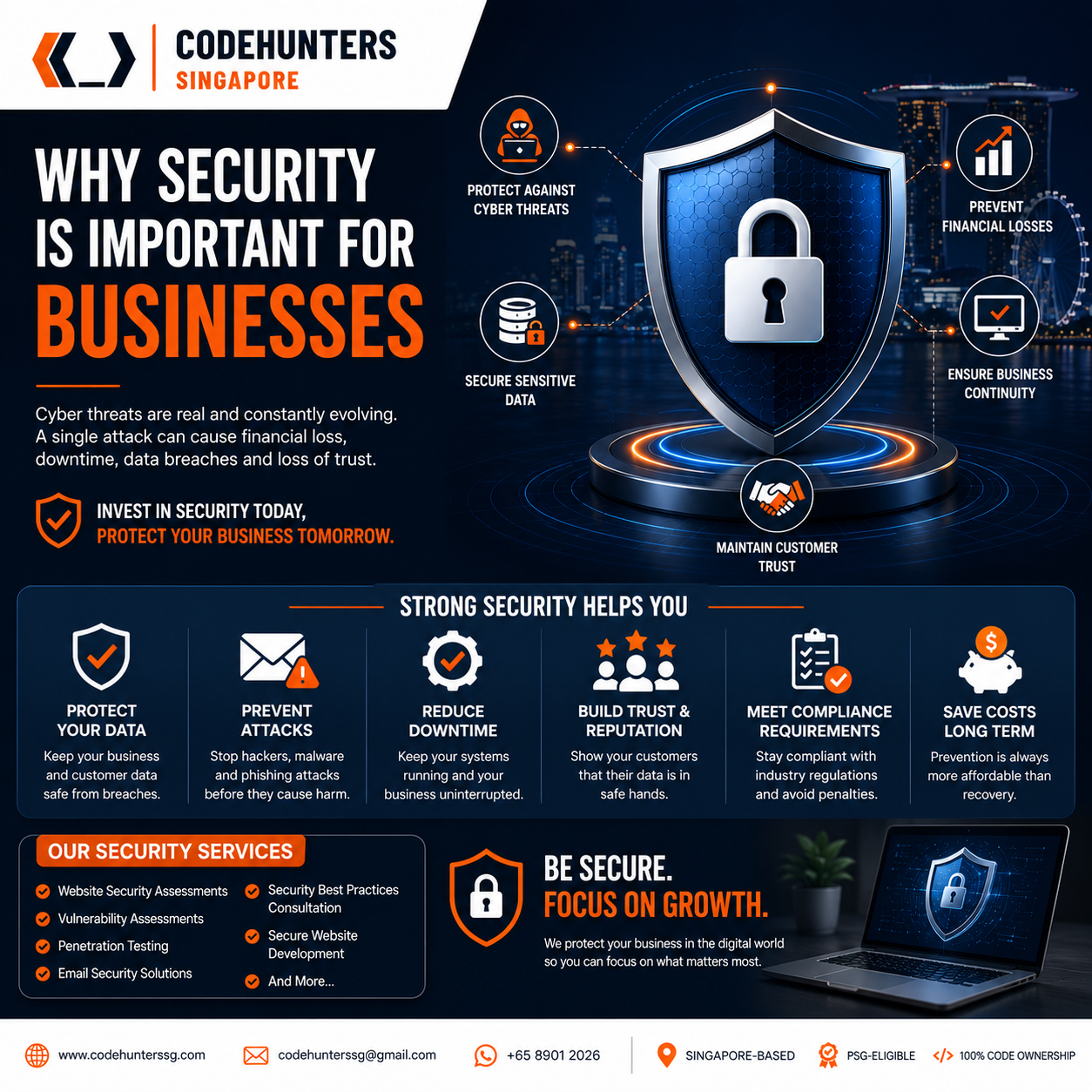
5 Cybersecurity Threats Every Singapore SME Should Watch in 2026
SMEs are now the preferred target for cybercriminals precisely
because they assume they are too small to be attacked. These are
the five attack vectors we see hitting Singapore businesses most
often — and the practical defences for each.
1. Phishing & business email compromise (BEC)
Fake invoices, spoofed supplier emails, and lookalike domains
remain the number-one entry point. BEC scams targeting finance
staff cause some of the largest single losses reported by SG businesses.
Defence:
enable multi-factor authentication on email, set up SPF/DKIM/DMARC
on your domain, and require phone verification for any change of
payee bank details.
2. Ransomware
Attackers encrypt your files and demand payment — increasingly
they also steal data first and threaten to publish it
(double extortion).
Defence:
offline or immutable backups tested quarterly, patched systems,
and endpoint protection on every device.
3. Credential stuffing
Passwords leaked from other breaches are replayed against your systems.
If your team reuses passwords, a breach elsewhere becomes your breach.
Defence:
a password manager, unique passwords per system, MFA everywhere,
and periodic checks for leaked credentials tied to your domain.
4. Lookalike domains & brand impersonation
Typosquatted domains impersonate your business to phish your
customers and suppliers — damaging trust you spent years building.
Defence:
monitor domain registrations similar to yours and report
impersonation early. This is exactly what our free Cyber Snapshot surfaces.
5. Supply-chain & third-party risk
Your security is only as strong as your vendors'. Compromised
plugins, agencies with shared passwords, and unvetted integrations
are common blind spots.
Defence:
least-privilege access for vendors, revoke credentials when
engagements end, and ask suppliers about their own security practices —
PDPA holds you accountable for data you pass to processors.
AI Chatbots vs Human Support — What Singapore SMEs Need to Know
The question isn't "bot or human" — it's which conversations
belong to each. Get the split right and you cover 24/7 without
burning out your team or your budget.
Where AI chat wins
-
After-hours coverage:
most SME enquiries arrive outside 9–6. A bot answers at 11pm
when your competitor's phone rings out.
-
Repetitive questions:
opening hours, pricing, delivery status, appointment slots —
the same 20 questions are typically the majority of volume.
-
Lead capture:
a bot that collects name, need, and contact number turns a
visitor into a qualified lead before your team even wakes up.
-
Bilingual service:
serving customers in English and Mandarin simultaneously is
expensive with staff, trivial for a well-trained bot.
Where humans still win
-
Complaints and refunds:
emotionally charged conversations need judgement and empathy.
-
Complex or high-value sales:
a S$20,000 project enquiry deserves a person within one business day.
-
Edge cases:
anything the bot hasn't been trained on should hand off gracefully —
never trap a customer in a loop.
The hybrid playbook
-
Let the bot handle first contact, FAQs, and lead capture on
WhatsApp — where Singapore customers already are.
-
Set clear escalation rules: keywords like "refund", "complaint",
or repeated confusion route to a human with full chat history.
-
Review transcripts monthly and retrain the bot on the questions
it fumbled.
Done well, SMEs typically automate the routine majority of chats
while improving response times on the conversations that matter.
The bot doesn't replace your team — it protects their time for
the work that needs them.
PDPA Compliance Checklist for Singapore Businesses — 2026 Edition
The Personal Data Protection Act applies to virtually every
business in Singapore that collects customer data — and penalties
can reach S$1 million or 10% of annual local turnover, whichever
is higher. Run through these 12 points.
Governance
-
Appoint a DPO — mandatory for every organisation,
and their business contact info must be publicly available.
-
Maintain a data inventory — know what personal
data you hold, where it lives, and who can access it.
-
Have a written PDPA policy — internal policy
plus a public-facing privacy notice.
Collection & consent
-
Collect only what you need —
data minimisation is your cheapest safeguard.
-
Get valid consent — tell people what you
collect and why, at or before collection.
-
Check Do Not Call registry — before
telemarketing to SG numbers, unless you have clear consent.
-
Honour withdrawal — make unsubscribing and
consent withdrawal easy and act on it promptly.
Protection & retention
-
Secure the data — access controls,
encryption in transit, and MFA on systems holding personal data.
-
Set retention limits — delete or anonymise
data once the business purpose is exhausted.
-
Bind your vendors — sign Data Processing
Agreements with anyone who processes data for you.
Response
-
Handle access & correction requests —
individuals can ask what data you hold; you must respond
within reasonable time.
-
Have a breach plan — notifiable breaches
must be reported to the PDPC within 3 calendar days of assessment.
Know who does what before it happens.
This checklist is a starting point, not legal advice — for complex
cases, consult the PDPC guidelines at pdpc.gov.sg or a qualified professional.
Why Most Singapore SMEs Fail at E-Commerce — And How to Win
Plenty of SG businesses launch online stores; far fewer make money
from them. The difference usually comes down to six avoidable mistakes.
1. Marketplace-only dependence
Shopee and Lazada bring traffic but take commissions, control your
customer data, and can change terms overnight.
Fix:
use marketplaces for discovery, but build your own store for
margin and repeat customers you actually own.
2. No clear differentiation
If your store looks like a template with the same products as
ten competitors, you compete on price alone.
Fix:
own a niche, write your own product content, and make your local
advantage (fast SG delivery, service, warranty) impossible to miss.
3. Painful checkout
Forced account creation, missing PayNow, and surprise shipping
fees kill conversions at the last step.
Fix:
guest checkout, local payment methods (PayNow, GrabPay, cards),
and shipping costs shown early.
4. Ignoring mobile
The majority of SG e-commerce traffic is mobile. A desktop-first
site with tiny buttons quietly loses most of its visitors.
Fix:
design mobile-first and test the full purchase flow on a real phone.
5. No post-purchase engine
Acquiring a customer is expensive; most stores never contact
them again.
Fix:
order-confirmation flows, review requests, and a simple email/WhatsApp
re-engagement sequence turn one-time buyers into repeat revenue.
6. Treating it as a one-off project
A store launched and abandoned decays fast — broken links, stale
inventory, slipping rankings.
Fix:
budget for iteration: measure, fix the biggest leak, repeat monthly.
The winning pattern is consistent: own your channel, remove friction,
and keep improving after launch. None of it requires a big-brand budget —
just deliberate execution.
How to Cut Payroll Time by 80% with HR Automation in Singapore
If month-end payroll means spreadsheets, CPF calculators, and late nights,
you're spending management hours on work software does better. Here's where
the time actually goes — and how automation gets it back.
Where the hours disappear
-
CPF & statutory calculations:
contribution rates vary by age band and residency status,
plus SDL and SHG fund deductions — every one a manual-error risk.
-
Leave reconciliation:
chasing paper forms and updating balances by hand.
-
Claims processing:
collecting receipts, checking policies, keying reimbursements into payroll.
-
Reporting:
preparing itemised payslips (mandatory under the Employment Act),
IR8A forms at tax season, and MOM-compliant records.
What automation changes
-
Statutory maths runs itself:
CPF, SDL, and fund deductions calculated from employee profiles —
updated when rates change, not when someone remembers.
-
Self-service leave & claims:
staff apply in an app; approvals flow to managers; balances
and payroll update automatically.
-
One-click payroll run:
salaries, deductions, and payslips generated together;
bank file (GIRO/FAST) exported ready for submission.
-
Compliance built-in:
itemised payslips, IR8A generation, and audit-ready records
without a separate filing exercise.
Making the switch
Start with the highest-volume pain: payroll and leave. Run the old
and new systems in parallel for one cycle to build confidence,
migrate historical records, then switch. For a 10–30 person team,
the typical result is payroll closing in hours instead of days —
with fewer errors and a clean trail when MOM or IRAS asks.
HR software is also a PSG-supported category, so eligible SMEs
may not pay full price. Check eligibility before you buy.





.png)